
With tax season quickly approaching, it’s a good time to remind everyone that the IRS doesn’t initiate contact with taxpayers by email, text messages or social media channels to request personal or financial information.
Please share this with your friends and family, especially those who are most likely to be targeted by these scammers.
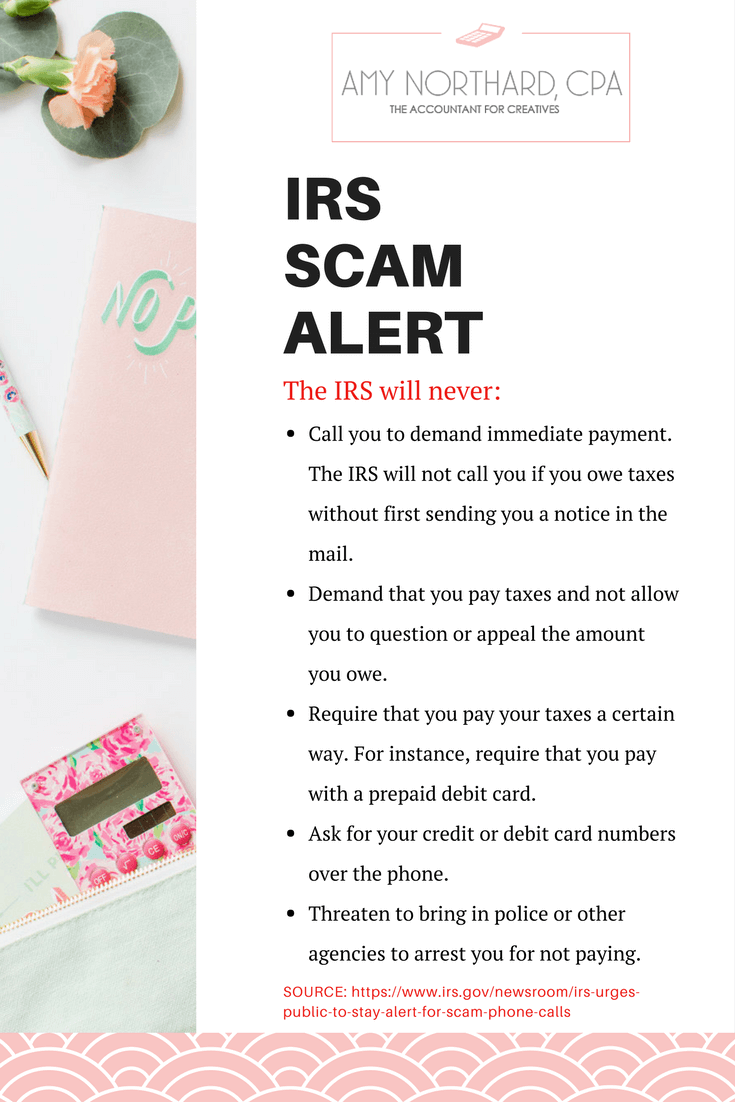
The IRS will never:
- Call you to demand immediate payment. The IRS will not call you if you owe taxes without first sending you a notice in the mail.
- Demand that you pay taxes and not allow you to question or appeal the amount you owe.
- Require that you pay your taxes a certain way. For instance, require that you pay with a prepaid debit card.
- Ask for your credit or debit card numbers over the phone.
- Threaten to bring in police or other agencies to arrest you for not paying.
If you receive one of these calls, please consider collecting their stated name, the phone number they are calling from and contacting TIGTA and the Federal Trade Commission.
- Contacting TIGTA to report the call. Use their “IRS Impersonation Scam Reporting” webpage. You can also call 800-366-4484.
- Reporting the call it to the Federal Trade Commission. Use the “FTC Complaint Assistant” on FTC.gov. Please add “IRS Telephone Scam” in the notes.
How the IRS will actually contact you
The IRS contacts taxpayers in specific, well-defined ways. Anything outside these channels is almost certainly a scam:
- By U.S. Postal Service mail. This is the IRS’s primary contact method. Real IRS notices arrive in plain official envelopes and include a notice number (CP- or LTR- followed by digits) in the top-right corner.
- By phone — but only after sending mail first. Real IRS phone contact follows previous correspondence. The agent will identify themselves with name, title, and badge number.
- In person — but only after sending mail first. Revenue Officers can visit taxpayers for collection cases or audits. They carry two forms of credential: an HSPD-12 card and a pocket commission.
- Through a private collection agency — only for old, low-priority debt the IRS has assigned out. The IRS currently contracts with just three agencies — CBE Group Inc., Coast Professional Inc., and ConServe — and they are limited to verification-and-payment-arrangement conversations. They cannot demand immediate payment or threaten arrest. If a caller claims to collect for the IRS under any other company name, it’s a scam.
The 5 biggest red flags of an IRS scam
- Demanding immediate payment without prior mail contact. The IRS always sends multiple written notices before any phone or in-person contact. A first contact via phone or email is a scam.
- Threatening arrest, deportation, or license revocation. Real IRS agents do not threaten these. Tax debts go through a legal process — they’re not resolved by an angry phone call.
- Asking for payment via gift card, wire transfer, cryptocurrency, or cash. The IRS accepts payment only via: their website (irs.gov/payments), check or money order, electronic funds withdrawal, debit/credit card via approved processors, or cash at participating retail locations (set up in advance). They never request gift cards.
- Asking for credit card or bank info over the phone. Real IRS agents direct you to make payments through official channels, not over the phone in real time.
- Refusing to send written confirmation. Any legitimate tax matter can be documented in writing. Scammers resist this because their story falls apart on paper.
Common scam patterns in 2026
- “You owe the IRS — pay now or be arrested.” Robocall with caller ID spoofed to look like an IRS number. Goal: gift card or wire payment.
- Phishing email with “your IRS refund” link. Email pretends to confirm a tax refund and asks you to click a link to enter banking details. The IRS does not initiate refund contact via email.
- Text message claiming a “tax transcript request” or an “unclaimed refund.” The IRS never initiates contact via SMS for tax matters. Scammers also still recycle old “stimulus eligibility” texts — the stimulus payment program ended years ago, so any such text is automatically a scam.
- Fake CP-2000 or CP-501 letters — physical mail that looks like an IRS notice but lists a non-IRS payment address. Always verify the address on the notice matches an IRS Service Center.
- Tax preparer impersonation — scammer pretends to be your CPA and asks for sensitive info via email. Verify by calling the CPA at the number you have on file (not the email contact).
What to do if you’re contacted
If you receive a suspicious contact claiming to be the IRS:
- Don’t pay or share personal info. Hang up the call or delete the email/text.
- Verify by calling the IRS directly at the official number 1-800-829-1040. Ask the agent to look up any case for your SSN. If they have nothing on file, the original contact was a scam.
- Report the scam:
- Phone scams → TIGTA (Treasury Inspector General for Tax Administration) at 1-800-366-4484
- Phishing emails → forward to [email protected]
- Suspicious text messages → forward to 7726 (your carrier’s spam reporting)
- Identity theft → IdentityTheft.gov + IRS Form 14039
- Check your IRS account at irs.gov/account. Real balances and notices appear here. If your account shows nothing, the contact was almost certainly fraudulent.
FAQs about IRS contact
Will the IRS ever email me?
The IRS does NOT initiate contact via email. They may email if you’re already in active communication with a specific revenue officer who has confirmed an email channel — but the first contact is always by mail. Any “first contact” email claiming to be the IRS is a phishing attempt.
Will the IRS call me about my refund?
No. Refund-status calls are a common scam pattern. Check your refund at irs.gov/refunds using the “Where’s My Refund?” tool, or by calling the IRS yourself at 1-800-829-1954.
What does a real IRS notice look like?
Real notices arrive in white envelopes with the IRS return address (typically Austin TX, Kansas City MO, or other Service Centers). The notice itself has a notice number in the top-right (formats like CP14, CP501, LT11), your specific tax year, the IRS phone number, and a specific dollar amount and explanation. Fake notices often have generic threats, blurry seals, or odd payment addresses.
What if I missed a real IRS notice and now they’re calling me?
Ask the caller for their name, badge number, and the notice number that was previously sent. Real agents will provide this readily. Then hang up and call the IRS directly at 1-800-829-1040 to verify. Real cases will show up in IRS records under your SSN; fake ones won’t.